

But What If We're Wrong?

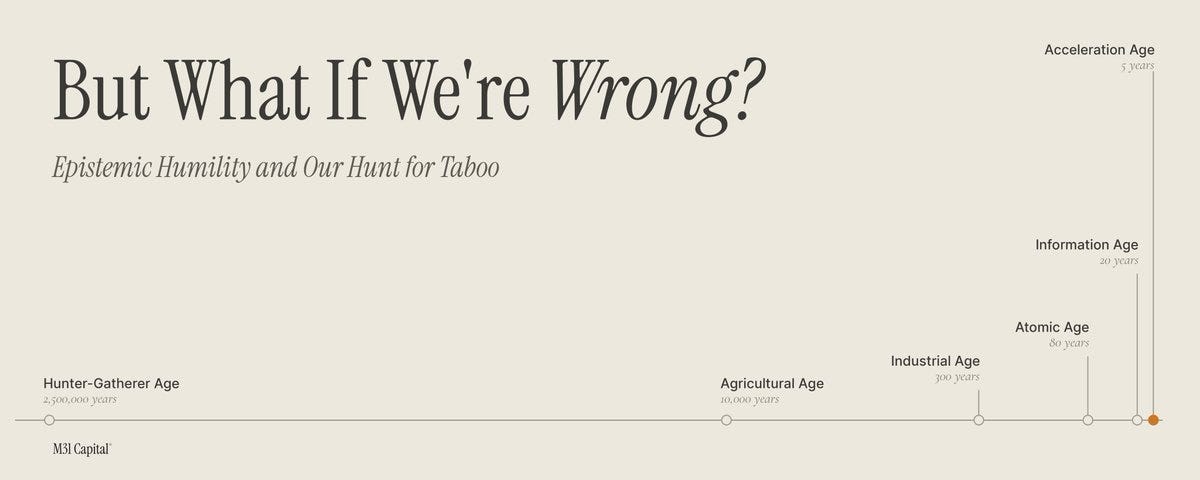
From Geocentrism to the Food Pyramid, humanity continues to be enormously, collectively wrong about things it believes with maximum confidence.
We were told Bitcoin would never succeed. It became a reserve asset of sovereign nations. We were told Donald Trump could never win. He won twice. We were told negative interest rates were impossible. Europe ran them for years. The population bomb never exploded. The climate apocalypse has been rescheduled more times than anyone can count.
Our collective assumptions about how the world around us operates are shaped and shared by educated peers and credentialed institutions, compounding over generations into conventional wisdom. Until one day, it is discovered to be wrong. Not by a little. Exactly backwards.
Intellectual honesty would require acknowledging that we are holding shared views right now, views that guide how we live, work, and interact, that are fundamentally and profoundly wrong.
The Pattern
Being wrong is not an outlier. It’s a pattern. Society consistently fails to update its worldview to account for the fact that it is without question wrong about something incredibly important today.
Before the Enlightenment, Copernicus and Galileo used empiricism to battle the dogma and conventional wisdom of the day. Their controversial ideas about the cosmos ushered in the Scientific Revolution. But their insight into how the world really worked was considered dangerous by the Church, and therefore everyone else. Even though Copernicus and Galileo were right, and the rest of the world eventually wised up, the existing paradigm persisted. That’s because throughout history each new discovery, no matter how radical, is treated as an historical anomaly, an amendment rather than a revolution that calls on humanity to reconstruct everything that it knows and believes to be true. The result is humans continue baking all that is wrong, all of their mistaken assumptions, into the next version of history.
For the last thirty years, we were told with absolute certainty that the planet was existentially overpopulated. Families that had more than two children were considered a reckless danger to society. Out of dutiful consideration to the planet, Millennials chose not to have children at all.
But the true existential danger turned out to be the exact opposite. Today, every country in the developed world has a birthrate below replacement, except Israel. As a result, a major depopulation wave is underway. This generation of South Koreans will live to see their population drop by 90%.
Every day our understanding of the world, of ourselves, what we are capable of individually and collectively, is shaped by experts. But this New York Times / Harvard MBA / McKinsey class has proven to be catastrophically wrong, time and time again.
Consensus is Not a Truth-Seeking Function
Our inability to recognize how consistently error prone humans truly are is not a failure of intelligence. It’s not a bug, it’s a feature of socialization. Every society exists within a paradigm that defines the limits of acceptable thought. These boundaries are defended with taboo, stigma, and mockery.
Financial advisors were laughed at for researching Bitcoin. Medical professionals were discredited for taking psychedelics seriously. Theoretical physicists lost grant funding for exploring topics outside of string theory.
But just as Giordano Bruno’s breakthroughs in astrophysics during the Renaissance were considered sufficiently heretical for the Catholic Church to burn him at the stake, the heterodoxy of today is similarly tarred and feathered. Psilocybin represented a form of “heretical healthcare” that threatened the pharmaceutical industry, so the consensus turned on it, and the FDA classified it a Schedule I narcotic in the same category as heroin despite evidence showing the opposite: not only no danger like heroin addiction, but a promising cure for overcoming it. Similarly, Satoshi’s vision of decentralized money represents a “heretical economics” that challenges the authority of the Central Bank and the state itself. Satoshi remains in hiding to this day. The very real threat of imprisonment, political targeting, and violence has since befallen many others in the industry.
The pattern that emerges is the suppression of alternative ideas irrespective of whether they’re right or wrong. Cross the line and you lose funding or tenure or social status in the hierarchy that gives your conclusions weight and value. Upon closer inspection, it becomes clear the intensity of this enforcement is correlated with the degree of threat an idea poses to the existing order. When the establishment fights an idea with disproportionate energy, it’s a revealing tell. Historically, there is no louder signal that a powerful idea has been found.
The Suppression is the Signal
This has led us at M31 to a simple principle: Taboo is a compass. We follow evidence rather than the crowd. We do not dismiss ideas simply because they make the credentialed class uncomfortable. That reflex has historically led to expensive mistakes.
Throughout humans’ history of being wrong, taboo is a precursor to sea change. That’s why M31 deliberately engages with radical ideas. We explore those thoughts that exist on the fringe of the current technological and scientific paradigm not because they are always valid, but because truly transformative ideas are always found on the frontlines of the war for truth. The boundary where incumbent powers use stigma to combat new thinking is where the most important signals reside. The penalty for intellectual timidity is following the crowd into consensus that is at best already priced in and at worst dead wrong.
UAP propulsion signatures in documented military encounters imply physics the standard model cannot explain. The official institutional response to such thinking has, for decades, been ridicule and dismissal followed by sudden, urgent congressional testimony. If that trajectory feels familiar it’s because we’ve seen it before.
We explore quantum vacuum energy because even a low-probability breakthrough in our understanding of the quantum vacuum would be the most consequential scientific discovery in history. The expected value of rigorous investigation into the unexpected is unquestionably high.
We study non-ordinary states of consciousness, longevity biology, and brain-machine interfaces because the biomedical paradigm we currently exist in is younger than the television set. The question of what human biology is actually capable of remains almost entirely open and unanswered.
At M31, we apply the same scientific rigor to anomalous phenomena that we apply to any investment thesis. If you want to know where the borders of the current paradigm are, ask yourself: “What am I not allowed to talk about?”
What is Today’s Geocentrism?
We are not interested in being provocative or heterodox for its own sake. We aim to discover new truths about the world before others and invest in them. That means exploring the places where the crowd is most sure of itself.
We are constantly looking out for things society is collectively wrong about today. We took Bitcoin seriously in 2011 exactly when it was dismissed as “magic internet money.” We invested despite the taboo, investing through the stigma and nation-state suppression. The signal was familiar: maximum institutional dismissal, disproportionate suppression, and an underlying technology that solved a real problem the existing paradigm would prefer remained unsolved.
This same framework applies to every sector we now investigate. The questions we return to, in every research cycle, are: “What is today’s geocentrism?” “What is tomorrow’s Bitcoin?” Put another way, “What is society wrong about now?”
At M31 Capital, our job is to live at the frontier of science and technology and experiment with heretical ideas. We see it as our job to never stop asking the question:
“But what if we’re wrong?”
— NJM
Another brilliant essay by the brilliant NJM! Bravo!
your point on gepcentrism is same energy as the bifurcation thesis we tracked from a specialist crypto VC last week, both pointing to consensus suppression as the strongest signal.