

The Atomic Turn
The hydrocarbon paradigm is in what Asimov & Kuhn both called the Crisis Phase. Every desperate move for molecules now accelerates the adoption of atoms.

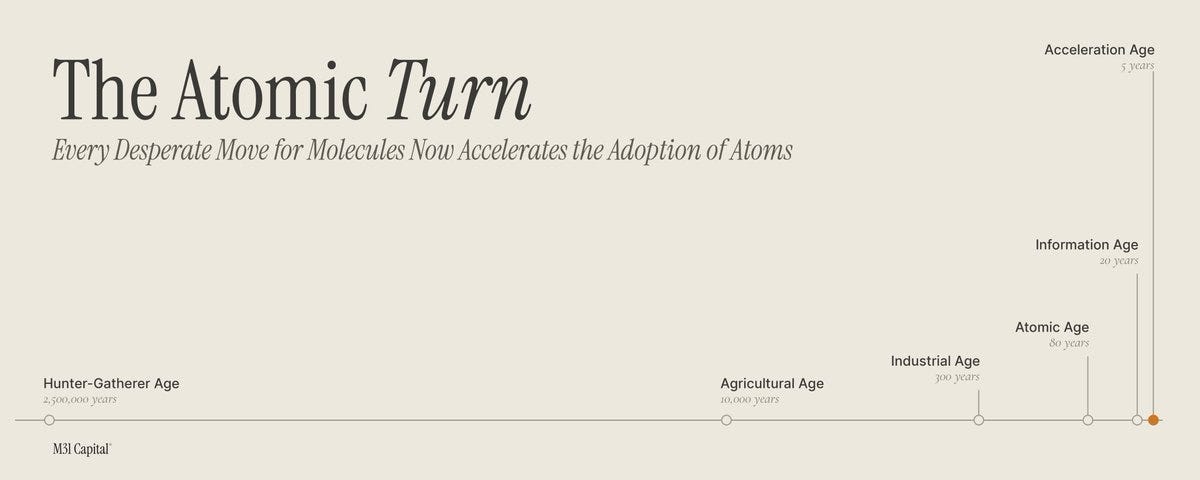
On February 28, 2026, the United States and Israel launched an air war against Iran. Within hours, the Islamic Revolutionary Guard Corps began broadcasting warnings across the Strait of Hormuz that ship passages were no longer permitted. By March 2, the closure was official. Tanker traffic through the world’s most important energy chokepoint fell by roughly seventy percent in days. Brent crude crossed $100 for the first time in four years. It peaked at $126. The month of March 2026 produced the largest monthly increase in oil prices ever recorded, and the largest disruption to world energy supply since the OPEC embargoes of the 1970s.
Every oil-dependent nation felt it. Every refinery recalculated. Every car-dependent city remembered what it actually costs when the molecules stop flowing.
And somewhere in a control room in Brussels, in Tokyo, in Washington, an official who had for years nodded politely at the phrase “energy transition” looked at a spreadsheet and realized that the transition was no longer theoretical.
This is what Thomas Kuhn called the crisis phase.
How Paradigms Die
In The Structure of Scientific Revolutions, Kuhn described how dominant models of the world collapse. He wrote about science (geocentrism giving way to heliocentrism, phlogiston to oxidation, classical mechanics to relativity), but the framework applies to anything built on a shared paradigm. Economic systems. Political regimes. Energy infrastructures. The civilizational operating software.
Paradigms do not die because they are debated out of existence. They die in stages. First, for long stretches, they work. What Kuhn called normal science, the period in which practitioners solve problems within the accepted framework and treat the framework itself as invisible. Then anomalies appear. Small ones at first. Edge cases the existing model cannot explain. Defenders ignore them, dismiss them, or paper them over with increasingly elaborate adjustments. This phase can last decades.
Then the anomalies stack. The adjustments multiply. The model becomes less a description of reality than a defense mechanism against it. At some point the pressure becomes unbearable and the system enters crisis: a period of high confusion in which incumbents double down, authority fractures, and a competing model begins to look not just possible but preferable. The crisis ends overnight. Kuhn’s term for the final moment was the gestalt switch: one day the figure is a duck, the next day the same pattern is a rabbit, and no argument reverts it. The paradigm is simply gone.
Power is rarely surrendered peacefully. It happens via crisis, or as Max Planck memorably put it, “one funeral at a time”.
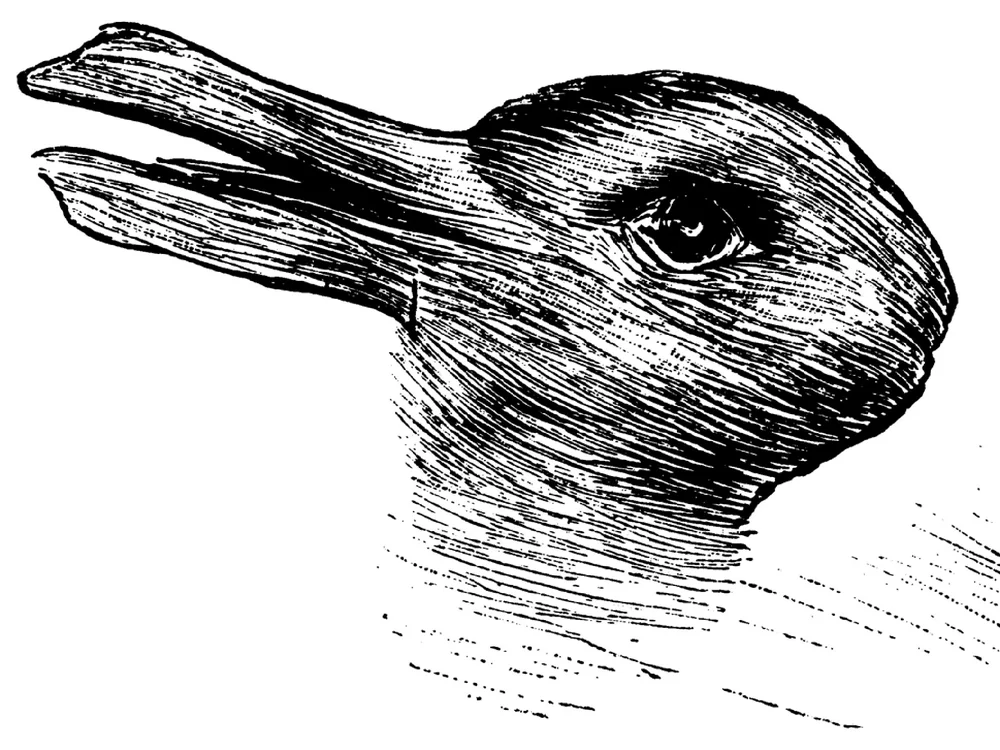
Jastrow’s duck-rabbit, the image Kuhn used to describe the gestalt switch. Once the reader sees the rabbit, it cannot be un-seen.
A Century of Molecules
The hydrocarbon paradigm had a good run. A little more than a century of industrial-grade normal science in which every nation’s security, every currency’s stability, every army’s mobility, and every city’s electrification rested on the same assumption: that energy comes from molecules buried in the ground, that these molecules must be dug up, refined, and physically transported to power a physical world.
The anomalies accumulated quietly. Germany deindustrialized after cutting itself off from Russian gas and discovering that an economy built on cheap molecules cannot survive expensive ones. Europe spent three winters paying multiples of what American consumers paid for the same thermal unit. The entire AI boom, the largest capital deployment in technology history, ran headfirst into a grid that could not provide the baseload it required, and the hyperscalers began signing power purchase agreements with nuclear operators that no Silicon Valley model had ever imagined. China, meanwhile, quietly began constructing more than thirty reactors and sprinting toward thorium. Small modular reactors moved from PowerPoint to construction site. The unmentionable word, nuclear, began to appear in green-party platforms.
And then Iran closed the strait.
Empires Die Loud
The crisis phase of a dying paradigm looks the same across every domain. The defenders of the old order make their most violent, most expensive, most irrational moves, not because they are strong, but because they are dying.
The failing company goes on a senseless acquisition spree. The roulette player bets his last fifty dollars on a single number. The quarterback throws a Hail Mary.
In Asimov’s Foundation, the Galactic Empire becomes the most violent in its latest stages. Its violence is not a sign of vitality, but an unconscious awareness of its mortality. A collapsing empire is most dangerous not at its height but in its twilight, and the same applies to scientific paradigms.
Putin’s gas coercion. OPEC’s production cuts. Iran closing the Strait of Hormuz: molecule weaponization, molecule manipulation, molecule hostagization. These are not acts of strength. They are the system’s antibody response to its own obsolescence: the last visible effort to remind the world that it still controls the chokepoints, still writes the price, still owns the map.
But every one of these moves accelerates the thing it is trying to prevent.
Suppression is Advertising
There is a specific pattern in how dying paradigms die. The harder the incumbent squeezes, the more obvious the alternative becomes.
When the U.S. banking system unconstitutionally debanked blockchain technology companies in 2022 and 2023 under Operation Chokepoint 2.0, the intention was to strangle Bitcoin in the cradle. The actual effect was to prove, publicly to hundreds of millions of people, that every argument for Bitcoin’s existence was correct. A monetary network that cannot be politicized was no longer an abstract ideal, but a genuine necessity. By the time the Strategic Bitcoin Reserve was announced in 2025, the suppression had done more to legitimize the asset than any marketing campaign ever could.
The Strait of Hormuz closure is the energy-paradigm analog. Every day the strait is shut, every dollar crude climbs, every insurance premium that doubles on a tanker’s passage, every European industrialist watching gas futures: each of these is a lived argument for an energy system that does not run through chokepoints. That does not require pipelines. That does not depend on the political stability of a regime ten thousand miles away. That cannot be closed by a man in Tehran or a man in Moscow or a man anywhere, because it runs on the energy released by splitting an atom, or on photons that fall freely on every square meter of the planet.
The paradigm is dematerializing. Molecules in the ground replaced by atoms in the air.
From Logistics to Physics
The twentieth-century energy system was a logistics system disguised as an energy system. The pipelines, the tankers, the straits, the refineries, the gas stations: all of it existed because the energy had to come from somewhere specific, be moved to somewhere else, and be converted along the way. This is why the map of oil is a map of war. Every major twentieth-century conflict traces, somewhere in its roots, to the question of who controls which molecules and how they get from there to here.
The atomic paradigm does not have that problem. A small modular reactor can be placed next to a data center. A solar array can be placed on a roof. A fission reaction does not require a supply chain from another continent. In the language of networks, the atomic paradigm is distributed. The hydrocarbon paradigm is centralized. One is antifragile; the other has chokepoints.
When Kuhn’s gestalt switch finally lands, the hydrocarbon map will look to our children the way the feudal map looks to us. A relic of a different logic, preserved for nostalgia.
We are not there yet. But we are closer than today’s energy paradigm leaders want you to believe. The price signals are loud. The capital is rotating. The anomalies have accumulated.
The crisis phase is here.
— NJM